It's hard to be upset at Obama given what he's up against and what he's done so far to restore the rule of law to this beleaguered country, but this was a bit disappointing.
The LA Times reports -- and the NY Times editorial page rues -- the fact that Obama bypassed Thomas Saenz, a prominent civil rights lawyer and the counsel to the Mayor of Los Angeles, for an appointment to the Civil Rights division of the Department of Justice.
Saenz has been an important voice in the effort to make the rights of immigrants an important civil rights issue -- a frame for immigration policy that is sorely in need of development. In our policy debates, it is frustrating that immigration policy is so often discussed in terms of "homeland security" or law enforcement or border control or lots of other things that seem to involve weaponry. What's lost in all that discussion is the fact that immigrants, especially those who are undocumented, have basic human needs that don't always get met -- that is, immigration is a longstanding and pressing civil rights issue.
And framing really is everything here -- it shapes the way that we think about "The Problem," and it affects our view of the solutions. I remember feeling this most keenly when the INS got moved to the Department of Homeland Security in the aftermath of 9/11. My grandfather was an immigrant who worked in unsafe American coal mines and died of black lung. He and my grandmother were attacked by state troopers at the behest of mine owners when he tried to organize unions in those mines. They were happy to be in the US, grateful even. But in the aftermath of 9/11, they became national security threats!! My grandparents have both been dead for years, but it was an insult to their memory.
Saenz was their lawyer. He spent his career trying to address those problems. He has led the effort to protect immigrants from unwarranted police raids, and he's worked on trying to secure rights to social services for immigrant populations. But because of these efforts, he's been labeled as an extremist. Google his name and see all the hysterical right wing propaganda that bubbles up.
Obviously, we don't know for sure, but that right wing hysteria is probably what kept Obama from naming Saenz to this post. But Rep. Luis Gutierrez (D-IL) noted the irony for us: “In what other position do you find that your life experience, your educational knowledge and commitment to an issue actually hurts you?”
Don't get me wrong -- it's all an improvement over the past 8 nightmarish years. Still, I sense that there will be more disappointments like this along the way.
Wednesday, March 25, 2009

Saturday, July 15, 2006
Using Your Head: Racism and the World Cup
 Those of you who follow sports are most likely already familiar with the story: in the final game of this year’s World Cup, French footballer Zinedine Zidane delivered a staggering headbutt to Italian player Marco Materazzi following a brief spat of conversation between the two on the field. Zinedine was red-carded, and without their star player France lost to Italy. Naturally, people began to wonder – what did Materazzi say to Zidane? What was the incendiary comment that led the Frenchman to sacrifice his team’s star player at the very end of the most important match in soccer?
Speculation following the match fixated on the potentially racist nature of Materazzi’s comment. Zidane, born and raised in France, comes from an Algerian parentage – Kabyle, to be exact. But Zidane himself has said recently that while Materazzi had insulted his mother and sister, the Italian’s comments were in fact not of a racist nature. So why leap to the assumption that the comment had been racist? Racism is never very far from the topic of football in Europe. The FIFA (International Federation of Football Association) website expresses a clear concern for how racism manifests itself in the game throughout Europe; Sepp Blatter (the head of FIFA) has even said in the past that if crowds of fans continue to disturb players by chanting racist taunts from the sidelines, games could be called off.
While race and ethnicity has often become a contested subject in sports, both in the US and Europe, there may be something telling in how each conflict reflects a particular context – a specific web of privilege, power, cultural hegemony and politico-economic reality. The racial tension that manifests itself in European football today may embody the larger picture of racism in Europe. And I suggest that this particular manifestation, on the football field, may be worth studying. Why? I’m not entirely sure we, as social scientists, have thoroughly explored the concept of racism in Europe. As an American who researches Muslim legal mobilization in France, I’ve often used the term “racism” in describing certain activities of the far-right; but should I export my American understanding of racism to France? There’s a certain danger here, one that I’ve tried to be sensitive of, but do not have the tools to speak of accurately yet. So I have been asking myself:
1) Does racism come in different varieties? In other words, do different understandings of race and race relations vary from one national context to the next? It may all be the same monster in the end, but does it present itself differently?
2) What kind of analytical purchase would an understanding of racism that is more particular to, say, France, or Germany, give me in answering other questions about social movements? Or in doing comparative work in general? Does it matter that racism looks different, or is understood differently, in different parts of the world?
3) How would I seek to classify or understand “ideal types” of racism, or is that even the approach I would want to use? Might studying one specific area where racism manifests itself – like around football – help me to gain a richer understanding of racism within a particular context?
What are your thoughts on this subject? We’re so careful as scholars to specify the differences between, say, the “political left” in Italy and the US; between “secularism” in France and the US; might “racism” require a more thorough contextualization? Has this already been done, and/or there references out there to help us in doing this or starting such a project?
Friday, June 17, 2005
Same-Sex Marriage in Massachusetts
I know most of you probably saw this: Mitt Romney throwing his support behind a state constitutional amendment that would reverse the right for same-sex partners to marry.
I thought it was kind of interesting that Kris Mineau, president of the Massachusetts Family Institute supporting the amendment, said his group did not want the amendment to invalidate the marriages that had already occurred. He said: "The homosexual marriages that occurred happened because of a flawed decision" made by judges, and "it's unfair to penalize those people for a bad decision made by the courts."
Anyway, Massachusetts same-sex marriage activists think that the amendment will fail because of a general lack of public outrage. It seems 6000 same-sex couples have gotten married in MA, and it isn't changing much of anything. One activist quoted in the article suggested that Romney was just playing to a national GOP audience by supporting the amendment. (Hmmm . . . the Massachusetts governor sucking up to the GOP . . . .)
This post comes to you from Urbana, IL -- a purple part of the Bluest of Blue states, home of Barack Obama and Dick Durbin, Mayor-for-Life Daley, and Governor Rod "I'm-a-Bit-of-a-Butthead-but-I'm-a-Democrat" Blagojevich.
I thought it was kind of interesting that Kris Mineau, president of the Massachusetts Family Institute supporting the amendment, said his group did not want the amendment to invalidate the marriages that had already occurred. He said: "The homosexual marriages that occurred happened because of a flawed decision" made by judges, and "it's unfair to penalize those people for a bad decision made by the courts."
Anyway, Massachusetts same-sex marriage activists think that the amendment will fail because of a general lack of public outrage. It seems 6000 same-sex couples have gotten married in MA, and it isn't changing much of anything. One activist quoted in the article suggested that Romney was just playing to a national GOP audience by supporting the amendment. (Hmmm . . . the Massachusetts governor sucking up to the GOP . . . .)
This post comes to you from Urbana, IL -- a purple part of the Bluest of Blue states, home of Barack Obama and Dick Durbin, Mayor-for-Life Daley, and Governor Rod "I'm-a-Bit-of-a-Butthead-but-I'm-a-Democrat" Blagojevich.
Iranian Elections
A bit afield from "law and social movements," but here's an interesting "photo essay" about the elections in Iran. The web page author argues, interestingly, that the news media is sexualizing democracy in Arab states.
It is true that when we're being pitched on how great it is that the US is bringing democracy to the Arab world, we are reminded of how horribly women are treated in their autocratic regimes. For example, in Bush's bash-fest of the Iranian election, he complained about how women are being excluded as candidates. So real democracy in the Middle East, we're being led to believe, will lead to a glorious day of women's liberation . . . I guess.
The role of women and Islamic feminists in Middle Eastern politics is so incredibly complicated, I'd never expect Bush and his neo-cons to have a clue (not to mention the gross hypocrisy of bashing Iran for excluding women from its political processes but condoning Saudi Arabia, which doesn't even bother with elections, except at the local level). But that doesn't stop them from using women to peddle their foreign policy.
Oh, and isn't it fun listening to George Bush lecturing other countries about the problems in *their* election systems. My sister calls it Irony Deficiency Syndrome.
It is true that when we're being pitched on how great it is that the US is bringing democracy to the Arab world, we are reminded of how horribly women are treated in their autocratic regimes. For example, in Bush's bash-fest of the Iranian election, he complained about how women are being excluded as candidates. So real democracy in the Middle East, we're being led to believe, will lead to a glorious day of women's liberation . . . I guess.
The role of women and Islamic feminists in Middle Eastern politics is so incredibly complicated, I'd never expect Bush and his neo-cons to have a clue (not to mention the gross hypocrisy of bashing Iran for excluding women from its political processes but condoning Saudi Arabia, which doesn't even bother with elections, except at the local level). But that doesn't stop them from using women to peddle their foreign policy.
Oh, and isn't it fun listening to George Bush lecturing other countries about the problems in *their* election systems. My sister calls it Irony Deficiency Syndrome.
Tobacco Litigation Update
Something smelled fishy about the Justice Department's cave-in on the tobacco litigation, and yesterday, we found out why.
Apparently, the trial team didn't want to reduce the amount of damages DOJ was seeking. That decision came down from on high -- specifically, an Associate Attorney General, Robert D. McCallum, who has the distinction of being both a buddy of Bush's from Skull and Bones AND being a former partner in a law firm that represented R.J. Reynolds.
So the trial team wrote a memo documenting their objections to what they perceived as political interference, and then someone leaked that memo to the NY Times.
Nice . . . .
Hopefully, the Times won't lose interest -- as they so often do.
Apparently, the trial team didn't want to reduce the amount of damages DOJ was seeking. That decision came down from on high -- specifically, an Associate Attorney General, Robert D. McCallum, who has the distinction of being both a buddy of Bush's from Skull and Bones AND being a former partner in a law firm that represented R.J. Reynolds.
So the trial team wrote a memo documenting their objections to what they perceived as political interference, and then someone leaked that memo to the NY Times.
Nice . . . .
Hopefully, the Times won't lose interest -- as they so often do.
Sunday, June 12, 2005
McLibel
I just read this review of a documentary, McLibel, that sounds great. It's about the libel suit McDonald's brought against two English activists, Helen Steel and Dave Morris -- the mother of all SLAPPs.
Steel and Morris had been handing out leaflets (in 1984), complaining about the health risks of McDonald's food, as well as their manipulative advertising, the employment practices, and the impact McDonald's has on the environment. McDonald's sued them for libel, and the trial lasted 314 days -- the longest trial in English history. McDonald's finally won, a verdict that was upheld on appeal.
But Steel and Morris filed a suit against the English government in the European Court of Human Rights, complaining that English libel law violated their right to freedom of expression, and THEY WON! The ECHR ordered the British government to give them a new trial and to pay them damages. You can read about it here and here.
I know that SLAPPs are a constant threat against small, grassroots activist organizations, but this surely exposes the danger of such actions. Sure, McDonald's "won," but it's been an international public relations nightmare for them. People were talking about this before Fast Food Nation and Supersize Me ever came along. And now, there's a documentary regurgitating it -- you'll pardon the pun.
Also, it would be worth seeing the movie to see the kind of grassroots support Steel and Morris were getting. And who were their lawyers?
Steel and Morris had been handing out leaflets (in 1984), complaining about the health risks of McDonald's food, as well as their manipulative advertising, the employment practices, and the impact McDonald's has on the environment. McDonald's sued them for libel, and the trial lasted 314 days -- the longest trial in English history. McDonald's finally won, a verdict that was upheld on appeal.
But Steel and Morris filed a suit against the English government in the European Court of Human Rights, complaining that English libel law violated their right to freedom of expression, and THEY WON! The ECHR ordered the British government to give them a new trial and to pay them damages. You can read about it here and here.
I know that SLAPPs are a constant threat against small, grassroots activist organizations, but this surely exposes the danger of such actions. Sure, McDonald's "won," but it's been an international public relations nightmare for them. People were talking about this before Fast Food Nation and Supersize Me ever came along. And now, there's a documentary regurgitating it -- you'll pardon the pun.
Also, it would be worth seeing the movie to see the kind of grassroots support Steel and Morris were getting. And who were their lawyers?
Friday, June 10, 2005
Protests in Egypt
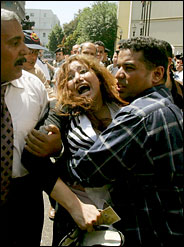
Protestor at Egyptian demonstration

At a political demonstration in Cairo calling for a more open democracy, a group of men chanting its support for Mubarak's ruling party harassed the protestors. In particular, this mob -- thought to have been sent by the government -- groped and beat up the women among the protestors.
Rather than intimidating anyone, the images of the beatings has apparently mobilized the opposition. In fact, the events have brought together fundamentalist Islamic groups and socialists. Kamal Khalil, director of the Center for Socialist Studies, told the New York Times, "At least now there is dialogue and meetings between us as Communists and the Muslim Brotherhood. We share our visions and there is a kind of coordination - of course, the event, assaults of Wednesday the 25th helped; we can't deny this." The event has also sparked the budding Islamic feminist movement in Egypt, fueling their organizational efforts.
The good kind of backlash.
Lawsuit Against Arrests for Panhandling
So the NYC police have been arresting people using a statute against panhandling that had been declared unconstitutional a decade ago. A class-action lawsuit was filed yesterday, and NYC prosecutors have already said they will take steps to stop the practice.
It's a nice topic for illustrating conflict theory in criminology courses. (But my favorite illustration of this was when Rudy Giuliani had the police arresting homeless people because they administrative sanitation regulations on proper disposal of trash. He instituted this program of sweeps because a mentally ill, "homeless" man attacked a woman leaving work, and Giuliani told the city that he was going to get these miscreants off the streets. Except the guy wasn't homeless. This was a little hard to teach in the immediate aftermath of 9/11 -- you know, when "everything changed" and Giuliani was a God. It's easier now.)
Anyway, this story is on the blog because of the lawsuit. The suit was brought by Matthew D. Brinckerhoff, a private attorney who filed the case with the Bronx Defenders. Indeed, the lawyers are not acting on behalf of a social movement organization (although I have a friend, Margareth Etienne at the U of I Law School who has a paper on public defenders as cause lawyers). The public defenders are also in a unique position to identify injustices like these -- they see lots of the same kinds of cases brought against individuals, and the lawyers can "collectivize" them.
Also, Brinckerhoff is a private attorney -- he's doing well by doing good. The core practice areas of the firm are civil rights and commercial law, which is an interesting combination. He's a cause lawyer, right? I mean, just because his offices are on Madison Avenue, and he makes some money doesn't mean he can't be a cause lawyer.
It's a nice topic for illustrating conflict theory in criminology courses. (But my favorite illustration of this was when Rudy Giuliani had the police arresting homeless people because they administrative sanitation regulations on proper disposal of trash. He instituted this program of sweeps because a mentally ill, "homeless" man attacked a woman leaving work, and Giuliani told the city that he was going to get these miscreants off the streets. Except the guy wasn't homeless. This was a little hard to teach in the immediate aftermath of 9/11 -- you know, when "everything changed" and Giuliani was a God. It's easier now.)
Anyway, this story is on the blog because of the lawsuit. The suit was brought by Matthew D. Brinckerhoff, a private attorney who filed the case with the Bronx Defenders. Indeed, the lawyers are not acting on behalf of a social movement organization (although I have a friend, Margareth Etienne at the U of I Law School who has a paper on public defenders as cause lawyers). The public defenders are also in a unique position to identify injustices like these -- they see lots of the same kinds of cases brought against individuals, and the lawyers can "collectivize" them.
Also, Brinckerhoff is a private attorney -- he's doing well by doing good. The core practice areas of the firm are civil rights and commercial law, which is an interesting combination. He's a cause lawyer, right? I mean, just because his offices are on Madison Avenue, and he makes some money doesn't mean he can't be a cause lawyer.
Thursday, June 09, 2005
Let's Study Countermovements
And finally, a chilling article about how religious right organizations are challenging the advances the LGBT movement has made in education.
These conservative Christian groups are pursuing a litigation strategy, challenging the inclusion of homosexuality in the curriculum of health education courses. One such group got a restraining order in federal court (huh?!?), and the County board later rescinded its approval of the use of the teaching materials. (Anyone know what the grounds of the restraining order were?).
Activists are also turning to state legislatures. "Alabama lawmakers are considering a bill that would bar state spending on books or other materials that "promote homosexual lifestyle." Oklahoma passed a resolution last month calling on public libraries to restrict children's access to books with a gay theme. Louisiana is considering a similar measure. "
Those of us who fall in love with our social movements really need to be thinking all the time about countermovements. Social movements don't operate in a vacuum, and these right-wing Christian movements -- and the successes they enjoy -- really shape the terrain of the public debate, not to mention policy, political opportunities, etc. I know those of you who study the LGBT movement never get very far away from these opponents, but it's a lesson to the rest of us to be thinking about who opposes the movements we study.
These conservative Christian groups are pursuing a litigation strategy, challenging the inclusion of homosexuality in the curriculum of health education courses. One such group got a restraining order in federal court (huh?!?), and the County board later rescinded its approval of the use of the teaching materials. (Anyone know what the grounds of the restraining order were?).
Activists are also turning to state legislatures. "Alabama lawmakers are considering a bill that would bar state spending on books or other materials that "promote homosexual lifestyle." Oklahoma passed a resolution last month calling on public libraries to restrict children's access to books with a gay theme. Louisiana is considering a similar measure. "
Those of us who fall in love with our social movements really need to be thinking all the time about countermovements. Social movements don't operate in a vacuum, and these right-wing Christian movements -- and the successes they enjoy -- really shape the terrain of the public debate, not to mention policy, political opportunities, etc. I know those of you who study the LGBT movement never get very far away from these opponents, but it's a lesson to the rest of us to be thinking about who opposes the movements we study.
Saudi Reformers
The article about Saudi reformers on the front page of the Times today was pretty interesting, mostly because of the absence of law and even the absence of social movements.
The article profiled several reformers in Saudi society who have been critical about the absence of civil liberties and civil rights, the treatment of women, and the prevalence of Wahhabism. One of those profiled, Turki al-Hamad, has had his novels banned. Another, Fawaziah al-Bakr, has been pushed out of teaching jobs because she has questioned the limited role for women in Saudi universities.
First, the article suggests that such reformers are isolated in Saudi society. They do not belong to organizations or mass movements militating for change. Their books get banned; they lose their teaching jobs. Both the state and civil society make it difficult for them to circulate their ideas, so that they never even reach a wider audience. And public debate about social change is frowned upon in general.
Law is largely a tool of repression. The article describes three activists who were arrested for circulating a petition seeking a constitutional monarchy. The activists and their lawyer were given jail terms ranging from 6 to 9 years.
Of course, law is not the most important source of meaning or form of social control. Religion has that honor, so the article contains the familiar account of the religious police harassing men and women who step outside the relatively strict codes of behavior prescribed by the Saudi form of Islam. (I wish the newspaper devoted as much critical coverage to US police harassing gays and lesbians or engaging in racial profiling as they do to the religious police in Saudi Arabia, but maybe that's just me.)
The article got me thinking -- we're all Rosenbergians now; we're pretty critical of litigation as a tool of social change, but it's obviously a matter of perspective. After all, a lawsuit does at least allow opponents of a regime to articulate a grievance and demand redress, all in relative safety. Think about the tobacco litigation -- it may not put the tobacco companies out of business, but it has exposed shady tobacco company practices and the case has been a subject of public debate about corporate greed. But maybe Mr. Hamad wishes he could sue the Saudi state to force it to lift the ban on his book and have a public discussion about censorship.
The article profiled several reformers in Saudi society who have been critical about the absence of civil liberties and civil rights, the treatment of women, and the prevalence of Wahhabism. One of those profiled, Turki al-Hamad, has had his novels banned. Another, Fawaziah al-Bakr, has been pushed out of teaching jobs because she has questioned the limited role for women in Saudi universities.
First, the article suggests that such reformers are isolated in Saudi society. They do not belong to organizations or mass movements militating for change. Their books get banned; they lose their teaching jobs. Both the state and civil society make it difficult for them to circulate their ideas, so that they never even reach a wider audience. And public debate about social change is frowned upon in general.
Law is largely a tool of repression. The article describes three activists who were arrested for circulating a petition seeking a constitutional monarchy. The activists and their lawyer were given jail terms ranging from 6 to 9 years.
Of course, law is not the most important source of meaning or form of social control. Religion has that honor, so the article contains the familiar account of the religious police harassing men and women who step outside the relatively strict codes of behavior prescribed by the Saudi form of Islam. (I wish the newspaper devoted as much critical coverage to US police harassing gays and lesbians or engaging in racial profiling as they do to the religious police in Saudi Arabia, but maybe that's just me.)
The article got me thinking -- we're all Rosenbergians now; we're pretty critical of litigation as a tool of social change, but it's obviously a matter of perspective. After all, a lawsuit does at least allow opponents of a regime to articulate a grievance and demand redress, all in relative safety. Think about the tobacco litigation -- it may not put the tobacco companies out of business, but it has exposed shady tobacco company practices and the case has been a subject of public debate about corporate greed. But maybe Mr. Hamad wishes he could sue the Saudi state to force it to lift the ban on his book and have a public discussion about censorship.
Tobacco Litigation Sell-Out
So the Bush Administration has decided to reduce the amount that it's seeking in the tobacco litigation. Experts thought that the stop-smoking program sought in the case needed about $130 billion, but the Bushies are asking for only $10 billion.
This is really no surprise -- they've been trying to de-rail the litigation since taking office in 2001. And apparently, Associate Attorney General Robert McCallum, Jr. has been taking an interest in the case -- which wouldn't be a big deal except that McCallum was a partner in a law firm in Atlanta that represented one of the big defendants, R.J. Reynolds. Justice department officials assure us that McCallum wasn't participating in the lawsuit; he just showed up in court during closing arguments. I guess he was just saying Hi to old friends. Yeah, that's it.
My favorite quotation in the Times article comes from some unnamed Justice department official who justifies the $10 billion figure by saying:
Trying to stay within a decision with which we disagreed? I'm sorry -- isn't that politics?
This is really no surprise -- they've been trying to de-rail the litigation since taking office in 2001. And apparently, Associate Attorney General Robert McCallum, Jr. has been taking an interest in the case -- which wouldn't be a big deal except that McCallum was a partner in a law firm in Atlanta that represented one of the big defendants, R.J. Reynolds. Justice department officials assure us that McCallum wasn't participating in the lawsuit; he just showed up in court during closing arguments. I guess he was just saying Hi to old friends. Yeah, that's it.
My favorite quotation in the Times article comes from some unnamed Justice department official who justifies the $10 billion figure by saying:
"This is not politics. This is exactly the contrary. This is trying
to stay within the law and trying to stay within a decision with which we
disagreed."
Trying to stay within a decision with which we disagreed? I'm sorry -- isn't that politics?
Wednesday, June 08, 2005
Indigenous and Labor Movements Toppling Government in Bolivia
There have been days of protests in Bolivia, lead by miners and indigenous groups who are protesting the free market policies of President Carlos Mesa. Even as the police have tried to disperse the protesters -- with tear gas and rubber bullets -- Mesa has offered his resignation, and the Bolivian Congress is expected to accept it.
One of the opposition leaders calling for new elections, Evo Morales, is a congressman in the party of Movement Toward Socialism. An Aymara Indian, Morales got his start in politics leading coca farmers protesting coca-eradication in the US War on Drugs. He and other opposition leaders are seeking nationalization of Bolivia's expanding energy industries.
Mesa is expected to be replaced by the President of the Supreme Court, Eduardo Rodríguez, who is politically popular and who has said he will only take the office as long as is necessary to hold elections.
One of the opposition leaders calling for new elections, Evo Morales, is a congressman in the party of Movement Toward Socialism. An Aymara Indian, Morales got his start in politics leading coca farmers protesting coca-eradication in the US War on Drugs. He and other opposition leaders are seeking nationalization of Bolivia's expanding energy industries.
Mesa is expected to be replaced by the President of the Supreme Court, Eduardo Rodríguez, who is politically popular and who has said he will only take the office as long as is necessary to hold elections.
Subscribe to:
Posts (Atom)